

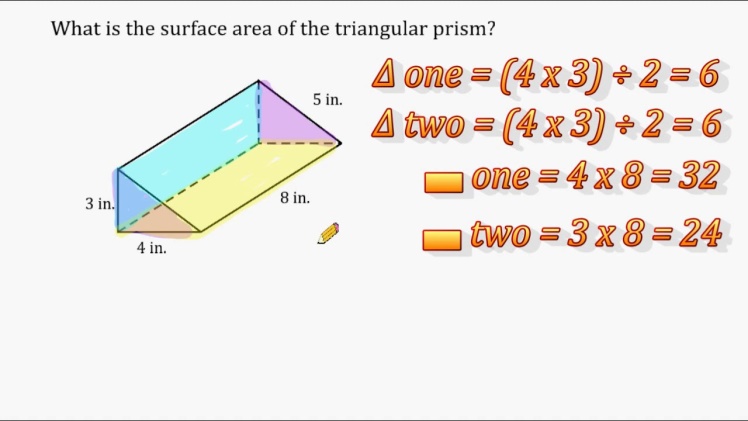
Triangular prisms are three-dimensional objects with six faces and nine edges. Finding the surface area of a triangular prism is a useful skill to have when trying to determine the total surface area of an object. This article will explain how to calculate the surface area of a triangular prism.
Calculating the Surface Area
The surface area of a triangular prism is equal to the sum of the areas of its six faces. To calculate the surface area of a triangular prism, you will need to find the area of each of its faces. The formula for the surface area of a triangular prism is:
Surface Area = 2(A + B + C) + 3H
Where A, B and C are the areas of the three triangular faces and H is the height of the prism.
Finding the Necessary Measurements
In order to calculate the surface area of a triangular prism, you will need to find the area of each of its triangular faces and the height of the prism. To find the area of each of the triangular faces, you will need to know the lengths of each side.
To find the height of the prism, measure the distance from the base of the prism to the top. Once you have all the measurements, you can use the formula to calculate the surface area of the triangular prism.
Calculating the surface area of a triangular prism is a straightforward process. All you need to do is find the area of each of the triangular faces and the height of the prism, then use the formula to calculate the surface area. With the right measurements and a bit of math, you will be able to quickly calculate the surface area of any triangular prism.
