

Introduction:
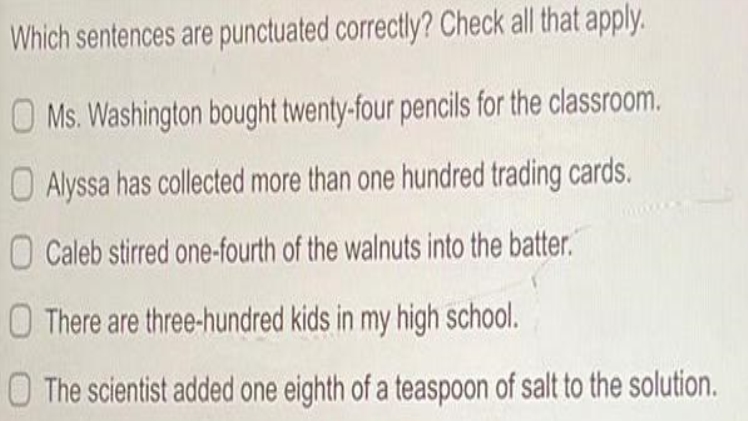
Proper punctuation is crucial in written communication to convey meaning effectively and ensure clarity. However, punctuating sentences correctly can sometimes be a challenge. In this article, we will explore a few examples of sentences and determine which ones are punctuated correctly. Let’s test your punctuation knowledge!
- “I went to the store and bought apples, oranges, and bananas.”
Correctly Punctuated: Yes
Explanation: This sentence is punctuated correctly. It includes a subject (“I”) and a predicate (“went to the store and bought apples, oranges, and bananas”) and uses appropriate commas to separate the listed items.
- “After work, I went to the gym but, I forgot my water bottle.”
Correctly Punctuated: No
Explanation: This sentence is not punctuated correctly. It should be written as follows: “After work, I went to the gym, but I forgot my water bottle.” The conjunction “but” should be preceded by a comma to separate the two independent clauses.
- “She is a talented musician, she plays the piano, guitar, and violin.”
Correctly Punctuated: No
Explanation: This sentence is not punctuated correctly. It should be written as follows: “She is a talented musician; she plays the piano, guitar, and violin.” The two independent clauses should be separated by a semicolon or a period.
- “The cat jumped off the table and onto the couch.”
Correctly Punctuated: Yes
Explanation: This sentence is punctuated correctly. It is a simple sentence with a subject (“The cat”) and a compound predicate (“jumped off the table and onto the couch”).
- “I have a meeting at 9 a.m., so I need to leave early.”
Correctly Punctuated: Yes
Explanation: This sentence is punctuated correctly. It contains an independent clause (“I have a meeting at 9 a.m.”) followed by a coordinating conjunction (“so”) and another independent clause (“I need to leave early”). The comma before “so” appropriately separates the two independent clauses.
- “He enjoys playing basketball, tennis, and golf.”
Correctly Punctuated: Yes
Explanation: This sentence is punctuated correctly. It consists of a subject (“He”) and a compound predicate (“enjoys playing basketball, tennis, and golf”). The commas are appropriately used to separate the listed activities.
Conclusion:
Correct punctuation is vital for effective written communication. In this article, we examined several sentences and evaluated their punctuation. It is essential to understand the rules surrounding commas, semicolons, and coordinating conjunctions to ensure proper punctuation. By continually practicing and improving punctuation skills, you can enhance the clarity and coherence of your writing.
